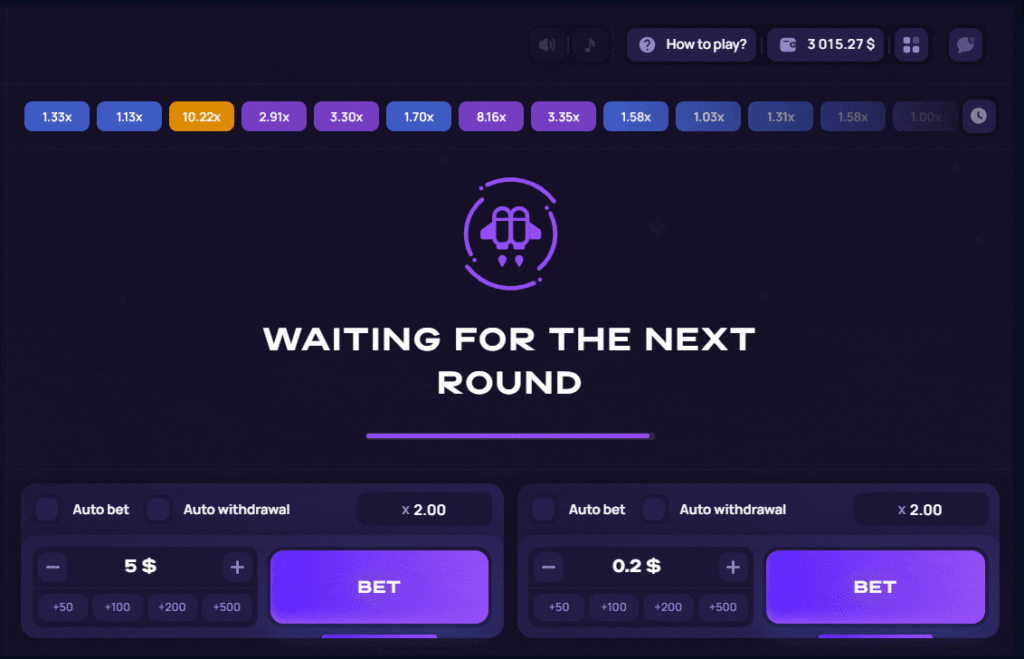
Gambling and cultural superstition often collide, and the UK’s landscape for crash-style games like Lucky Jet presents a perfect example https://lucky-jet.co.uk. At its core, Lucky Jet is a game of chance, driven by Random Number Generators. Yet many players wrap their gaming journey in broader ideas, particularly karma. Through a modern Western lens, they feel their own conduct and moral standing can influence the game’s random outcomes. In their view, Lucky Jet is no longer a straightforward calculation. It transforms into a tale about karmic balance. A ‘good’ day might mean the jet soars to a high multiplier. A ‘bad’ deed could cause it crash out early. This analysis examines how these karma-focused notions have seeped into the UK’s Lucky Jet scene. We will examine where they come from, how they appear, and the psychological relief they offer in a online environment full of uncertainty.
The idea of Karma: Eastern philosophy encounters UK Gaming
Karma is a concept from Dharmic faiths like Hinduism and Buddhism. It is a spiritual law of cause and effect. Traditionally, it addresses the ethical results of actions across many lifetimes, influencing what comes next. Inside the secular, quick-fire world of UK online gaming, this idea has transformed. It has been reduced to a more immediate, almost deal-making belief. The idea is that positive personal behaviour or thinking can lead to good results in Lucky Jet. Negativity, on the other hand, attracts loss. This version divests karma of its religious depth and its ties to rebirth. It converts karma into a universal force for fairness that works right now. This shift answers a human craving for story and justice, even inside systems built to be random. It lets players place their gaming within a personal moral frame that feels meaningful.
Moving from Spiritual Doctrine to Modern Metaphor
This cultural shift transforms karma from a strict spiritual teaching into an everyday metaphor for luck. In the UK, where different cultural ideas mix easily, karma has joined common talk. It often separates from its deep religious origins. People use it in daily chat to say someone «got what they deserved,» for better or worse. This everyday understanding forms a perfect bridge into gaming. Imagine a player hits a winning streak on Lucky Jet after they helped a neighbour. They might naturally link the two events. They use the modern karmic metaphor to explain the randomness. This establishes a personal superstition that seems intuitive and culturally okay. It fits right beside other common luck rituals, without asking for any serious religious belief.
Difference from Traditional Gambling Superstitions
Karma beliefs in Lucky Jet mark a change from classic UK gambling superstitions. Classic superstitions involve things like carrying a rabbit’s foot, avoiding the colour green, or puffing on dice. These are frequently symbolic, tactile, and concentrated on immediate, in-the-moment luck. They are outside charms. Karma belief is dissimilar. It is inner and ethical. It is more than a physical object and more about the player’s overall moral or emotional state over a longer stretch. A traditional gambler might tap on wood. A karma-focused Lucky Jet player might reflect on how they conducted themselves all week. This transition mirrors a broader cultural move towards mindfulness and self-improvement, even in leisure. It mixes the world of chance with the language of wellness and purpose. It presents a form of superstition that feels more intellectually weighty and personally responsible to a modern player.
Gambler Superstitions and Superstitious Habits
You can notice karmic belief in the Lucky Jet community through particular rituals. These are methods players try to align with positive karma or remove bad energy before or during a session. They serve as psychological warm-ups, creating a feeling of earned success. The rituals go further simple lucky charms. They often entail deliberate acts meant to create ‘good vibes’ or moral credit. For example, some players will perform a small kindness just before logging in. They might give a charity donation online or praise a stranger. They feel this act puts credit into a karmic bank. Others might clean their physical space thoroughly or take a moment to meditate. The goal is to start the game with a clear, positive, and therefore ‘deserving’ mind.
- The Clean Slate Ritual: Players might settle small debts, respond to old messages, or stop a petty argument before playing. This symbolically clears the karmic books.
- Environmental Purification: Tidying the gaming area, burning sage or incense, or arranging lucky crystals are thought to dispel negative energy that could lead to an early crash.
- Timing Based on Conduct: Opting to play only on days perceived as ‘good’ or virtuous. They steer clear of playing after a day full of frustration or anger, fearing that negativity will lead to loss.
- The Generosity Link: Purposefully giving a tiny part of a past win to charity. This gets framed as an investment for future karmic returns in the game.
The function of game mechanics and «Fair Play» Communication
The structure and promotion of Lucky Jet and analogous websites can subtly support karmic interpretations, although that is not the plan. They highlight terms like «fair play,» «transparent algorithms,» and «provably fair» tech. These expressions aim to convince players of the game’s integrity. But some players stretch that idea. They confuse mathematical fairness with a bigger notion of cosmic balance. If a game is presented as mathematically just, it is a small mental jump for some to think a just universe should also compensate personal goodness. Also, the aesthetic of a crash game assists. The jet climbing higher represents success. This effortlessly connects to metaphors of rising up, prize, and falling down. The game’s integrated story of creating tension and a sudden stop gives a perfect blank slate. Players impose their own karmic stories onto it. They see the crash not as a random number, but as a instant of judgement that suits their personal account.
Psychological Underpinnings: Control and Dealing
Taking on karma beliefs taps into basic psychological requirements. The main aspects are the need for command and a way to cope. Games of luck like Lucky Jet are erratic and ungovernable by nature. This unpredictability can generate nervousness and mental discomfort. To resolve this, the human mind looks for patterns and cause-and-effect connections, a phenomenon called illusory correlation. Having faith in karma allows a player to force a known, rule-based system onto a fundamentally rule-free random event. The principle is basic: good action leads to good consequence. This impression of mastery cuts nervousness. It renders gaming more entertaining and less of a mental strain. Furthermore, it works as an emotional buffer. A defeat attributed on your own karmic burden is oddly simpler to handle than a defeat blamed on sheer, meaningless randomness. The first suggests the universe has order and you can modify future consequences by improving yourself.
The narrative of «Merited» Triumphs and Losses
Karmic faith has a vital function: it constructs a strong narrative around victories and setbacks. It turns cold statistical happenings into narratives with moral source and effect. A gamer using this framework who prevails will often attribute the achievement not just to timing or chance, but to their own favorable state or recent good behaviors. This increases their perception of mastery and ability. On the other hand, a loss often gets framed as a karmic disharmony. Maybe they were too avaricious last time. Maybe they gambled while in a awful mood. This story functions as a buffer. It softens the sting of forfeiting money by situating it inside a larger, self-correcting tale of universal equity. It renders a possibly irritating event into a insight. The participant decides they must «merit» the next triumph through improved behaviour or outlook. This starts a pattern where gaming and perceived personal development merge together.
Group Tale-Telling and Support
These stories get powerful backup in online groups and platforms where UK Lucky Jet gamers assemble. Told tales of «karmic triumphs» after a good act, or warnings about loss following a mean behavior, become portion of the community’s folklore. This collective tale-telling makes the faith system normal. It gives social evidence and confirmation. A player recounts how they prevailed big after aiding a friend. Others answer with analogous stories. This forms a perceived sequence that seems statistically solid, even though chance is the dominant factor. This collective support is crucial for maintaining karmic beliefs active. It shifts them from a personal peculiarity to a shared cultural practice inside the gaming community. It gives a feeling of inclusion and mutual comprehension.
Doubt and the Reasoned Counterpoint
Naturally, many UK players and observers approach these karmic beliefs with firm doubt. The reasoned view is based in awareness of coding and odds. Lucky Jet’s result gets locked in by a cryptographic algorithm the moment a session starts. It has not any relation to any user’s thoughts, emotions, or behaviors. From this angle, connecting victories or losses to karma is a textbook instance of the post-hoc error. That signifies mistaking succession for consequence. Critics say such ideas can grow damaging. They may result to hazardous play, like going after deficits to «correct» supposed karmic obligation, or assuming you have greater influence than you actually possess. This push-and-pull between mystical narrative and statistical truth is a key discussion in the game’s culture. The majority of participants live somewhere between the two ends. They may do minor traditions for fun, while underneath recognizing randomness is the real mechanism.
Examining karma notions around Lucky Jet in UK culture demonstrates us how an old spiritual idea gets reformed for a modern digital activity. It does not work as a full religious custom. Alternatively, it serves as a individual system for narration, command, and dealing with emotions. These notions let users inject deep individual value into a mathematical series. They alter play into a epic of moral cause and outcome. The logical grasp of random number generation opposes solidly. Yet these ideas persist. Their longevity demonstrates how deeply people seek to identify structures, justice, and personal impact, even in arenas built to be unpredictable. Regardless of how you view it as a benign mental ease or a cognitive prejudice, the whole phenomenon shows how cultural traditions transform. They combine heritage, psychology, and tech in modern gaming world.